Ebook Free The Music of the Primes: Searching to Solve the Greatest Mystery in Mathematics, by Marcus du Sautoy
The Music Of The Primes: Searching To Solve The Greatest Mystery In Mathematics, By Marcus Du Sautoy As a matter of fact, book is really a home window to the globe. Also many individuals may not such as checking out books; guides will certainly constantly offer the precise information regarding fact, fiction, experience, experience, politic, faith, and a lot more. We are right here a web site that offers collections of books greater than the book establishment. Why? We provide you lots of numbers of link to obtain the book The Music Of The Primes: Searching To Solve The Greatest Mystery In Mathematics, By Marcus Du Sautoy On is as you need this The Music Of The Primes: Searching To Solve The Greatest Mystery In Mathematics, By Marcus Du Sautoy You can discover this publication conveniently right here.
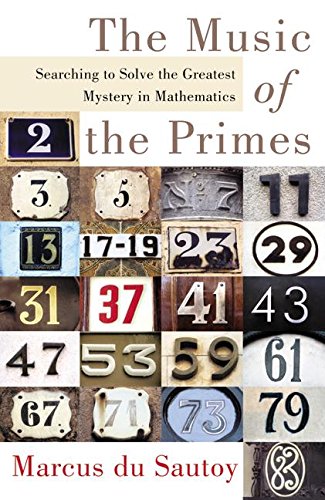
The Music of the Primes: Searching to Solve the Greatest Mystery in Mathematics, by Marcus du Sautoy

Ebook Free The Music of the Primes: Searching to Solve the Greatest Mystery in Mathematics, by Marcus du Sautoy
Invest your time even for just few mins to review a book The Music Of The Primes: Searching To Solve The Greatest Mystery In Mathematics, By Marcus Du Sautoy Reviewing an e-book will never ever minimize and also waste your time to be worthless. Checking out, for some people become a need that is to do daily such as hanging out for eating. Now, what about you? Do you prefer to check out an e-book? Now, we will certainly show you a brand-new e-book qualified The Music Of The Primes: Searching To Solve The Greatest Mystery In Mathematics, By Marcus Du Sautoy that can be a new means to discover the understanding. When reading this book, you can get one point to always keep in mind in every reading time, also step by action.
Reviewing book The Music Of The Primes: Searching To Solve The Greatest Mystery In Mathematics, By Marcus Du Sautoy, nowadays, will certainly not require you to always get in the store off-line. There is a fantastic location to purchase guide The Music Of The Primes: Searching To Solve The Greatest Mystery In Mathematics, By Marcus Du Sautoy by on-line. This site is the most effective website with great deals varieties of book collections. As this The Music Of The Primes: Searching To Solve The Greatest Mystery In Mathematics, By Marcus Du Sautoy will remain in this publication, all books that you need will correct below, as well. Merely look for the name or title of guide The Music Of The Primes: Searching To Solve The Greatest Mystery In Mathematics, By Marcus Du Sautoy You can discover exactly what you are hunting for.
So, even you need commitment from the business, you could not be confused anymore since books The Music Of The Primes: Searching To Solve The Greatest Mystery In Mathematics, By Marcus Du Sautoy will certainly consistently assist you. If this The Music Of The Primes: Searching To Solve The Greatest Mystery In Mathematics, By Marcus Du Sautoy is your finest companion today to cover your task or job, you could as quickly as possible get this book. Exactly how? As we have actually told formerly, just check out the web link that our company offer below. The conclusion is not just guide The Music Of The Primes: Searching To Solve The Greatest Mystery In Mathematics, By Marcus Du Sautoy that you look for; it is how you will obtain numerous books to sustain your ability and ability to have piece de resistance.
We will show you the very best and also most convenient method to obtain publication The Music Of The Primes: Searching To Solve The Greatest Mystery In Mathematics, By Marcus Du Sautoy in this globe. Bunches of compilations that will certainly support your task will certainly be right here. It will certainly make you really feel so perfect to be part of this site. Ending up being the member to always see exactly what up-to-date from this book The Music Of The Primes: Searching To Solve The Greatest Mystery In Mathematics, By Marcus Du Sautoy site will make you feel ideal to hunt for the books. So, recently, as well as here, get this The Music Of The Primes: Searching To Solve The Greatest Mystery In Mathematics, By Marcus Du Sautoy to download and install and wait for your valuable worthy.
Inthe tradition of Fermat’s Enigma and Pi, Marcus du Sautoy tells the illuminating, authoritative, and engagingstory of Bernhard Reimann and the ongoing quest tocapture the holy grail of mathematics—the formula to predict prime numbers.Oliver Sacks, author of The Man Who Mistook His Wife for a Hat, calls TheMusic of the Primes “an amazing book. . . . I could not put it down once Ihad started.” Simon Winchester, author of The Professor and the Madman,writes, “this fascinating account, decoding the inscrutable language of themathematical priesthood, is written like the purest poetry. Marcus du Sautoy's enthusiasm shines through every line of this hymnto the joy of high intelligence, illuminating as it does so even the darkestcorners of his most arcane universe.”
- Sales Rank: #252075 in Books
- Published on: 2003-04-29
- Released on: 2003-04-29
- Original language: English
- Number of items: 1
- Dimensions: 9.00" h x 1.13" w x 6.00" l,
- Binding: Hardcover
- 352 pages
From Publishers Weekly
The quest to bring advanced math to the masses continues with this engaging but quixotic treatise. The mystery in question is the Riemann Hypothesis, named for the hypochondriac German mathematician Bernard Reimann (1826-66), which ties together imaginary numbers, sine waves and prime numbers in a way that the world's greatest mathematicians have spent 144 years trying to prove. Oxford mathematician and BBC commentator du Sautoy does his best to explain the problem, but stumbles over the fact that the Riemann Hypothesis and its corollaries are just too hard for non-tenured readers to understand. He falls back on the staples of math popularizations by shifting the discussion to easier math concepts, offering thumbnail sketches of other mathematicians and their discoveries, and occasionally overdramatizing the sedentary lives of academics (one is said to be a "benign Robespierre" whose non-commutative geometry "has instilled terror" in his colleagues). But du Sautoy makes the most of these genre conventions. He is a fluent expositor of more tractable mathematics, and his portraits of math notables-like the slipper-shod, self-taught Indian Srinivasa Ramanujan, a mathematical Mozart who languished in chilly Cambridge-are quite vivid. His discussion of the Riemann Hypothesis itself, though, can lapse into metaphors ("By combining all these waves, Riemann had an orchestra that played the music of the primes") that are long on sublime atmospherics but short on meaningful explanation. The consequences of the hypothesis-a possible linkage to "quantum chaos," implications for internet data encryption-may seem less than earth-shaking to the lay reader, but for mathematicians, the Riemann Hypothesis may be the "deepest and most fundamental problem" going. 40 illustrations, charts and photos.
Copyright 2003 Reed Business Information, Inc.
From Scientific American
The unpredictable drip from a leaky faucet can drive almost anyone mad. Prime numbers, those divisible only by one and themselves, present a numerical equivalent. For centuries, mathematicians have tried to find a simple formula to describe where these numbers fall along the number line. But their spacing--1, 2, 3, drip, 5, drip, 7, drip, drip, drip, 11, drip, and so forth--seems to defy prediction. In 1859 German mathematician Bernhard Riemann uncovered an apparent key to unlocking the pattern, but he couldn't verify it. Many great minds have become obsessed with proving his guess, referred to as the Riemann Hypothesis (RH), ever since. Three books published in April chronicle this quest. The books cover much of the same ground, but each has a different strength. The text with the simplest title, The Riemann Hypothesis, by science writer Karl Sabbagh, provides ample hand-holding for anyone who pales at the sight of symbols or can't quite distinguish an asymptote from a hole in the graph. In Prime Obsession, by John Derbyshire, a mathematically trained banker and novelist, Riemann and his colleagues come to life as real characters and not just adjectives for conjectures and theorems. And in The Music of the Primes, written by University of Oxford mathematics professor Marcus du Sautoy, the meaning of Riemann's work unfolds by way of rich musical analogies. Why three books on the same difficult subject now? One obvious answer is that the notoriety of the RH only recently spread to circles beyond math-faculty common rooms. In 2000 the Clay Mathematics Institute (CMI), a private research organization funded by Boston banker cum math fan Landon T. Clay, offered a $1-million prize for the solution. The move won Riemann almost as many posthumous headlines as Fermat. CMI offers the one-buck bounty on seven outstanding mathematical mysteries. These so-called millennium problems are a 21st-century follow-up to German mathematician David Hilbert's famous stumpers, presented in 1900 to the Second International Congress of Mathematicians in Paris. The Riemann Hypothesis is the only problem to make both lists, a century apart--and with good reason: it is exceedingly complex, and a mounting number of results require that it be true. Timing, too, has played a part. At the end of the 18th century Carl Friedrich Gauss, one of Riemann's mentors, produced what was then the best approximation for the number of primes less than some number N--namely, N/log N. This value is sometimes too big and sometimes too small, but Gauss predicted that the error would shrink for larger Ns. By the end of the 19th century Jacques Hadamard and Charles de la Vallée Poussin proved this suggestion, called the prime number theorem (PNT). The RH was the next obvious mark. Riemann's original wording does not mention prime numbers at all but instead addresses the so-called zeta function, ?(s) = 1 + 1/2s + 1/3s + 1/4s + ... 1/ns. For s = 1, this function is the familiar harmonic series. For inputs greater than one, however, zeta becomes more exotic. Swiss mathematician Leonhard Euler discovered in the 1700s that for s = 2, zeta converges on the square of pi divided by six. It was a startling find. The decimal expansion of pi is unpredictable, and yet by way of the zeta function, it could be summed from an infinite series of neat fractions. Euler's break was the first such "zeta bridge" between seeming randomness and order. Riemann forged the next by feeding the zeta function complex numbers, those of the form a + bi, having both real and imaginary parts. These numbers were a new invention at the time. Riemann had learned about them in Paris and brought them back to Göttingen, where he studied under Lejeune Dirichlet, Gauss's successor. The older man was well acquainted with the zeta function, which he had invoked to prove one of Fermat's prime-number assertions. For Riemann, then, it was a small leap to try the new numbers in the old function. To sum up what these books take 300-plus pages to explain, Riemann homed in on points for which the zeta function fed with imaginary numbers equaled zero and viewed these "zeros" as waves--much as Euler had produced sine waves corresponding to musical notes from plugging imaginary numbers into the exponential function 100 years before. Riemann further made a connection between these waves and his own refinement of Gauss's PNT, dubbed R(N): by adding R(N) to the height of each wave above N, he could generate the exact number of primes less than N. The location of the zeros, therefore, led to that of the primes, and Riemann asserted that the zeros followed a simple pattern. They all had a real part of 1/2. In other words, were you to graph zeta, the zeros would fall along a single line. Each of the books satisfactorily presents Riemann's math--as much as it is possible to do so for a general audience--but they offer very different reading experiences. The Music of the Primes made me feel as if I were sitting through a gracefully worded lecture. The Riemann Hypothesis is more journalistic, relying on quotes from working mathematicians to tell the story. Parts of Prime Obsession read almost like a novel, others like a mathematical text. Its author, Derbyshire, segmented the book so that most of the math falls into odd chapters and the history and biographical material in even ones, but the math is as interesting as the rest. When will the RH be solved? None of the books dares to predict. Hilbert, one of the greatest mathematicians of all time, forecasted that it would happen within his lifetime. He died in 1943. In other words, it's still anyone's guess.
Kristin Leutwyler turned from the study of mathematics to journalism, serving until recently as editor of Scientific American's Web site. Now a freelance writer, she is the author of the forthcoming book The Moons of Jupiter (W. W. Norton, 2003).
From Booklist
*Starred Review* Thanks to Du Sautoy's exceptional gift for translating professional insights into plain language, general readers can now contemplate prime numbers (numbers--such as 3, 5, 7, and 11--not divisible by any smaller whole number) with something of the wonder and awe that these numbers have stirred among mathematicians since the days of Euclid. In a capacious and wide-ranging narrative, Du Sautoy traces the swelling of interest in primes during the last 250 years as mathematicians have searched for some hidden pattern behind their apparently random sequence. After the greatest pioneer in this search, German mathematician Bernhard Riemann, intuited a hypothetical looking-glass harmony in the primes, ambitious minds around the world embarked on a quest to prove his daring conjecture. Yet today a million-dollar prize for such a proof remains unclaimed, as the best and brightest admit defeat. The absence of a buttressing proof, however, has not prevented the Riemann Hypothesis from growing ever more important to theoretical scientists (in quantum physics and chaotic systems) and practical technicians (in cryptography and electronic security). Fortunately, whether dealing with nuclear energy levels or credit-card encryption, Du Sautoy alloys his lucid explanations of mathematical principles with piquant anecdotes about the cross-grained personalities who have developed them--from a womanizing Oxford cyclist to a paranoid Buddhist recluse. A book that will draw readers normally indifferent to the subject deep into the adventure of mathematics. Bryce Christensen
Copyright © American Library Association. All rights reserved
Most helpful customer reviews
0 of 0 people found the following review helpful.
An excellent history of the mathematic fraternity over the past three ...
By Piet van Niekerk
An excellent history of the mathematic fraternity over the past three or four centuries. The Riemann hypothesis being the one major challenge for the other mathematicians to prove right or wrong. The author follows a step by step timeline with the prodigious attempts in each period explained in detail. Easy to read and follow if you are mathematically inclined and difficult to put it down.
4 of 4 people found the following review helpful.
DO NOT GET KINDLE VERSION.
By Peter Lau
KINDLE VERSION is text only where paper version has illustrations.
0 of 0 people found the following review helpful.
Good content, bad paper
By Amazon Customer
The author is a distinguished mathematician so this work is trustful. Sometimes the pop-science books written by journalist or so are not accurate in some sense. The coverage is comprehensive and he discussed about some most recent (up to the time when writing) mathematicians.
The bad news is that the paper quality is not good. It feels like the book you can find in super market for $1. The only advantage is that it is light weight.
The Music of the Primes: Searching to Solve the Greatest Mystery in Mathematics, by Marcus du Sautoy PDF
The Music of the Primes: Searching to Solve the Greatest Mystery in Mathematics, by Marcus du Sautoy EPub
The Music of the Primes: Searching to Solve the Greatest Mystery in Mathematics, by Marcus du Sautoy Doc
The Music of the Primes: Searching to Solve the Greatest Mystery in Mathematics, by Marcus du Sautoy iBooks
The Music of the Primes: Searching to Solve the Greatest Mystery in Mathematics, by Marcus du Sautoy rtf
The Music of the Primes: Searching to Solve the Greatest Mystery in Mathematics, by Marcus du Sautoy Mobipocket
The Music of the Primes: Searching to Solve the Greatest Mystery in Mathematics, by Marcus du Sautoy Kindle

No comments:
Post a Comment